Where Hayward's floors are
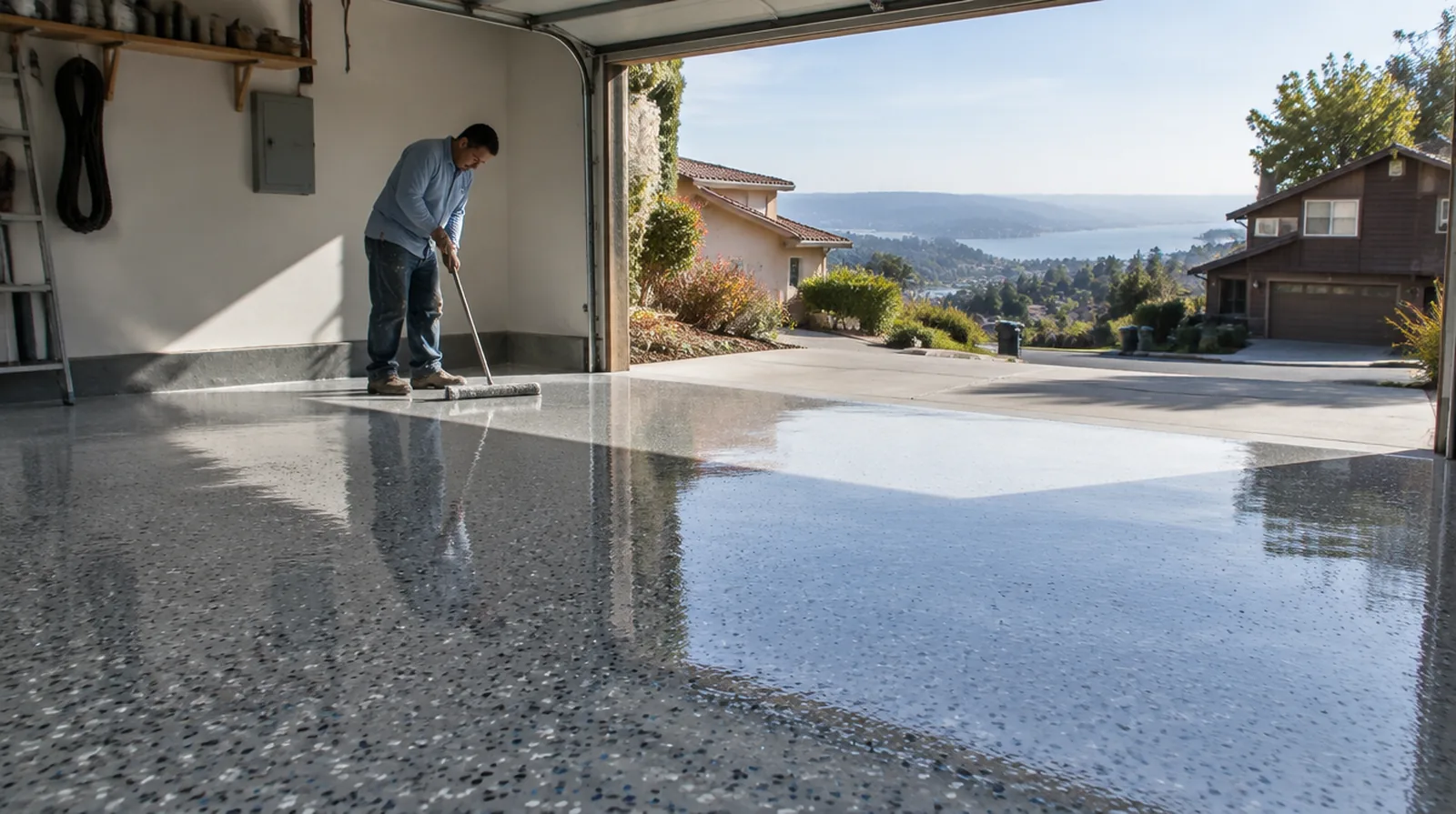
West of 880, the industrial corridor along Industrial Parkway, Clawiter and Whitesell holds hundreds of warehouses, bakeries, beverage plants, cabinet shops and fabricators. Those slabs see forklifts, pallet jacks, wash-down hoses and forty years of patches. East of Mission Boulevard, the hill neighborhoods near Cal State East Bay and the older blocks around downtown have homes with one- and two-car garages that are begging for a better floor.
We work both sides of town, with equipment sized for a single garage or a 30,000 square foot building.
Living on a fault line
Hayward sits right on top of the Hayward Fault, which creeps a few millimeters a year. You can see it in offset curbs downtown. Garage and warehouse slabs here tend to have more cracks than most, and some of them move. Before we coat, we map the cracks, decide which can be filled solid and which need a flexible filler, and tell you honestly where a hairline might show again later.
Services
For warehouses and plants: industrial epoxy and urethane systems and densified polished slabs. For homes: garage epoxy, color chip floors, one-day polyaspartic and poured metallic. For everyone: coating repair and outdoor concrete sealing.
Inside the house, we also pour epoxy countertops over tired tile and laminate in kitchens, ADUs and wet bars.
Out back, our pool deck coating restores grip on older East Bay cool deck.
Mild weather, wet winters
Hayward rarely gets very hot or very cold. Bay breezes keep summers comfortable, and the rain comes between November and March. Slabs near the shoreline can stay damp from below, so we take a moisture reading on every job.
Can you coat a food plant floor?
Yes. We install slip-resistant, cleanable systems with cove bases for sanitation.
My garage has a long crack across it. Is that the fault?
Probably not directly, but ground movement and settling are common here. We assess every crack before coating.
Do you work weekends?
Yes, especially for businesses.
Hills, flatlands and the industrial west side
Hayward runs from the hills around Cal State East Bay down through downtown and the B Street area, across neighborhoods like Mt. Eden, Tennyson and Fairway Park, and out to the industrial blocks near the shoreline. Hillside garages tend to be tucked under the house and can stay damp in winter. Flatland homes often have slabs from the 1950s with decades of wear. The west side is full of food plants, warehouses and shops. An epoxy floor in Hayward has to be planned around whichever of those you are in.
From the shoreline warehouses to the Highlands
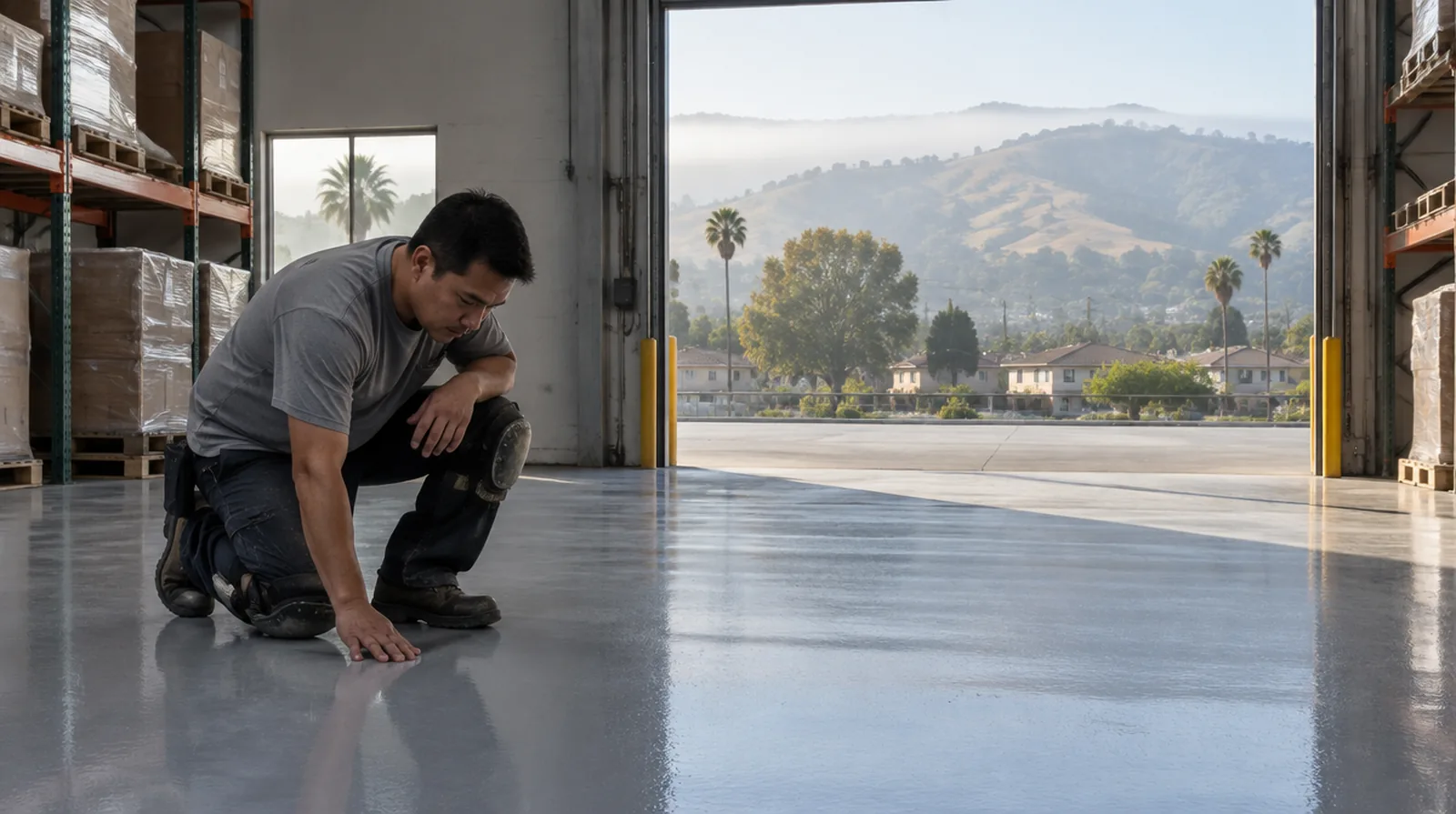
Ask ten Hayward property owners what their concrete goes through and you get ten different answers. A distribution building off Clawiter Road has pallet jacks pivoting in the same aisle thousands of times a week. A bakery near Industrial Parkway has hot water and sanitizer on the floor every night. A family in Jackson Triangle parks two cars in a garage poured when Eisenhower was president, and a retired couple in the Hayward Highlands has a tuck-under garage that smells faintly damp every February. All of them call it a floor. Each of them needs a different one.
That is why we start every Hayward job by walking the space with you instead of quoting a square-foot number over the phone. We look at how the slab was finished, where water collects, what rolls across it, which cracks are old and stable and which are still opening, and how many days you can actually give up the room. The system we recommend follows from those answers, not from whatever product is easiest to sell.
What older Hayward slabs usually tell us
Much of the flatland housing between Mission Boulevard and the 880 went up in the late 1940s and 1950s, when the town was growing fast around the canneries and the new freeway. Those garage slabs are thin by modern standards, often without a vapor barrier, and many have been painted two or three times. Paint has to come off completely, and the bare concrete underneath tends to be soft at the surface, so we grind deeper and use a primer that soaks in. Homes in Fairway Park, Tennyson and Harder-Tennyson often have expansion joints filled with old felt or tar that must be dug out before any coating goes near them.
Up the hill, houses around Prospect Hill, Hayward Highlands and the streets near Cal State East Bay sit on sloped lots. Water moves downhill through the soil and right up against the back wall of a garage built into the grade. On those floors a moisture reading is not a formality. It decides whether we can use a standard epoxy primer or need a moisture-mitigating one first.
Businesses on the west side
The industrial district west of the freeway is one of the largest in the Bay Area, and its buildings range from 1960s concrete block shops to tilt-up warehouses built in the last few years. Older buildings commonly have saw-cut joints that have spalled at the edges from decades of hard wheels. Newer ones may have a curing compound on the surface that blocks adhesion until it is ground away. For food and beverage operators we talk through drain locations, cove base height and cleaning chemicals before choosing between epoxy, urethane cement and a polished slab. For warehouses we plan work in zones so shipping never fully stops.
Marine air and the rainy months
Hayward's weather is gentle compared with the inland valleys, but it still shapes installs. Morning fog and marine air keep humidity up, which slows how fast some coatings cure. From roughly November through March, ground near the shoreline and in the low parts of town holds water. We schedule accordingly, measure air temperature, dew point and slab temperature on the day, and use faster or slower curing products to match. In the dry months, a garage with the door shut can be coated, cured and back in use on a predictable timeline.
More questions from Hayward owners
Can you coat a garage that has a water heater and furnace in it? Yes. We coat around the platforms and keep pilot lights and vents in mind when picking low-odor materials.
Do you need the whole building empty for a commercial floor? No. We can split a floor into phases and move racks or equipment with your team between them.
What should I do before the estimate visit? Just clear enough space for us to see the floor and the worst cracks. We will handle measuring and testing.
Get a floor assessment
Call (510) 880-3198 for a free visit in Hayward.